
Targeting stress-regulated PCNA functions in cancer
Cancer cells are continuously exposed to cellular stress caused by rapid proliferation, genomic instability, altered metabolism and anti-cancer treatment. To survive, they activate adaptive pathways that promote DNA repair, damage tolerance, cell survival and therapeutic resistance.
APIM Therapeutics has developed a novel therapeutic approach that selectively targets these stress responses by selectively disrupting stress-regulated protein-protein interactions involving Proliferating Cell Nuclear Antigen (PCNA), a multifunctional scaffold protein that coordinates numerous cellular processes essential for cancer cell survival.
PCNA – a multifunctional scaffold protein
PCNA (Proliferating Cell Nuclear Antigen) is best known for its essential role in DNA replication. Beyond its canonical role in DNA replication, extensive research has demonstrated that PCNA functions as a multifunctional scaffold protein coordinating the activity of hundreds of proteins involved in DNA repair, DNA damage tolerance, cellular signaling, apoptosis, metabolism and immune regulation.
These interactions are mediated through conserved PCNA-binding motifs, primarily the PIP-box (PCNA-Interacting Protein box) and the APIM (AlkB homolog 2 PCNA-Interacting Motif)1-2.
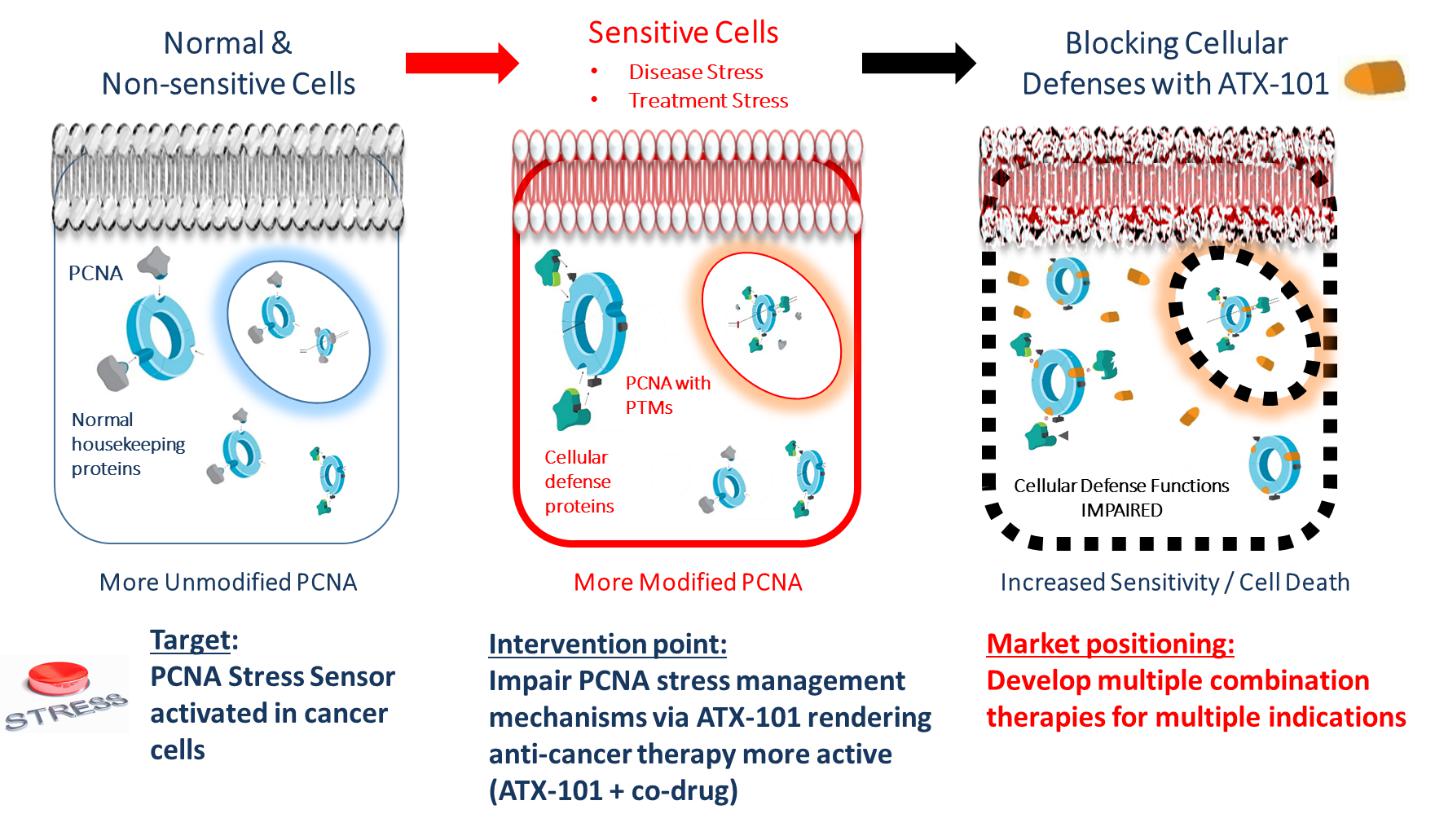
High-affinity PIP-box proteins are predominantly involved in normal cellular "housekeeping" functions such as DNA replication. In contrast, many APIM-containing proteins regulate cellular stress responses. During cellular stress, post-translational modifications (PTMs) of PCNA reshape the PCNA interactome, increasing the importance of APIM-mediated protein interactions that coordinate adaptive stress-response pathways.
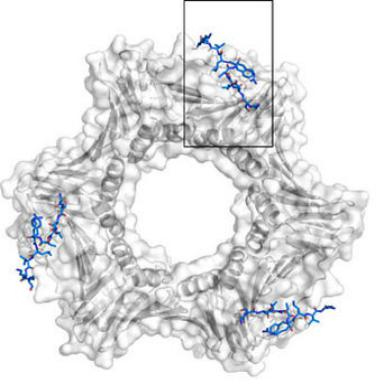
Figure: Shows a front view of the PCNA ring (grey surface and ribbons) binding a PIP peptide (yellow sticks) from ZRANB3 (Zinc-finger, RAN-Binding domain containing 3) at the hydrophobic pocket in the same region where APIM binds. Figure reproduced without change in agreement with Creative Commons Attribution 4.0 International License provisions (see herein), from Sebesta M et al, Nat Commun. 2017 Jun 16;8:15847 (original Figure 6a in the publication).
A novel therapeutic intervention point
The APIM sequence was discovered by Professor Marit Otterlei and colleagues at the Norwegian University of Science and Technology (NTNU). More than 300 proteins have subsequently been identified that contain an APIM sequence, many of which participate in DNA repair, DNA damage tolerance, cellular signaling, apoptosis and metabolic regulation.
Because cancer cells experience persistent cellular stress, they become increasingly dependent on APIM-mediated PCNA interactions to maintain survival and resist anti-cancer therapy. This stress-dependent biology provides a unique opportunity to selectively target stress-adapted cancer cells while largely preserving the essential housekeeping functions mediated by high-affinity PIP-box interactions.
Selectively targeting cancer cell stress responses
ATX-101 is a proprietary cell-penetrating peptide containing the APIM sequence. By competing with endogenous APIM-containing proteins for binding to PCNA, ATX-101 selectively disrupts stress-regulated PCNA interactions in cancer cells. Rather than inhibiting a single signaling pathway, ATX-101 modulates multiple cellular mechanisms involved in DNA repair, DNA damage tolerance, apoptosis, cellular signaling, metabolism and immune regulation, thereby impairing the ability of cancer cells to adapt to stress induced by anti-cancer therapy. By impairing the ability of cancer cells to respond to treatment-induced stress, ATX-101 enhances the activity of multiple classes of anti-cancer therapies, including chemotherapy, targeted agents and radiotherapy. In tumor types characterized by particularly high levels of intrinsic stress, such as glioblastoma and multiple myeloma, ATX-101 has also demonstrated single-agent activity by directly inducing apoptosis in cancer cells3.
Clinical translation
ATX-101 is the first PCNA-targeting therapeutic to enter clinical development. Preclinical studies have demonstrated broad anti-tumor activity both as a single agent and in combination with numerous anti-cancer therapies across multiple tumor models. Clinical studies have confirmed a favorable safety profile together with encouraging signs of anti-tumor activity, supporting the continued development of ATX-101 in combination with standard-of-care cancer treatments.
ATX-101 is the first PCNA-targeting therapeutic to enter clinical development. Extensive preclinical studies have demonstrated broad anti-tumor activity both as a single agent and in combination with numerous anti-cancer therapies across multiple tumor models.
A first-in-human Phase I study demonstrated a favorable safety profile together with encouraging disease stabilization in patients with advanced solid tumors who had exhausted standard treatment options. The study results have been published in Oncogene4. A copy of the corresponding publication is available here.
Building on these findings, APIM Therapeutics has advanced ATX-101 into multiple clinical development programs. A completed Phase Ib study in platinum-sensitive ovarian cancer demonstrated a favorable safety profile in combination with platinum-based chemotherapy together with encouraging anti-tumor activity. In soft tissue sarcoma, encouraging clinical observations from an investigator-initiated Phase II study, combined with extensive preclinical combination data, have supported the ongoing development of ATX-101 in combination with standard chemotherapy. Additional clinical development programs, including glioblastoma, are further expanding the therapeutic potential of ATX-101 across multiple tumor types.
For more information on the underlying biology and clinical studies, see Publications.